现在《中国语言学报》2026年54卷第2期(Journal of Chinese Linguistics Vol. 54, No.2)已出版。下面,我们将推送JCL最新一期(第54卷第2期)文章摘要——
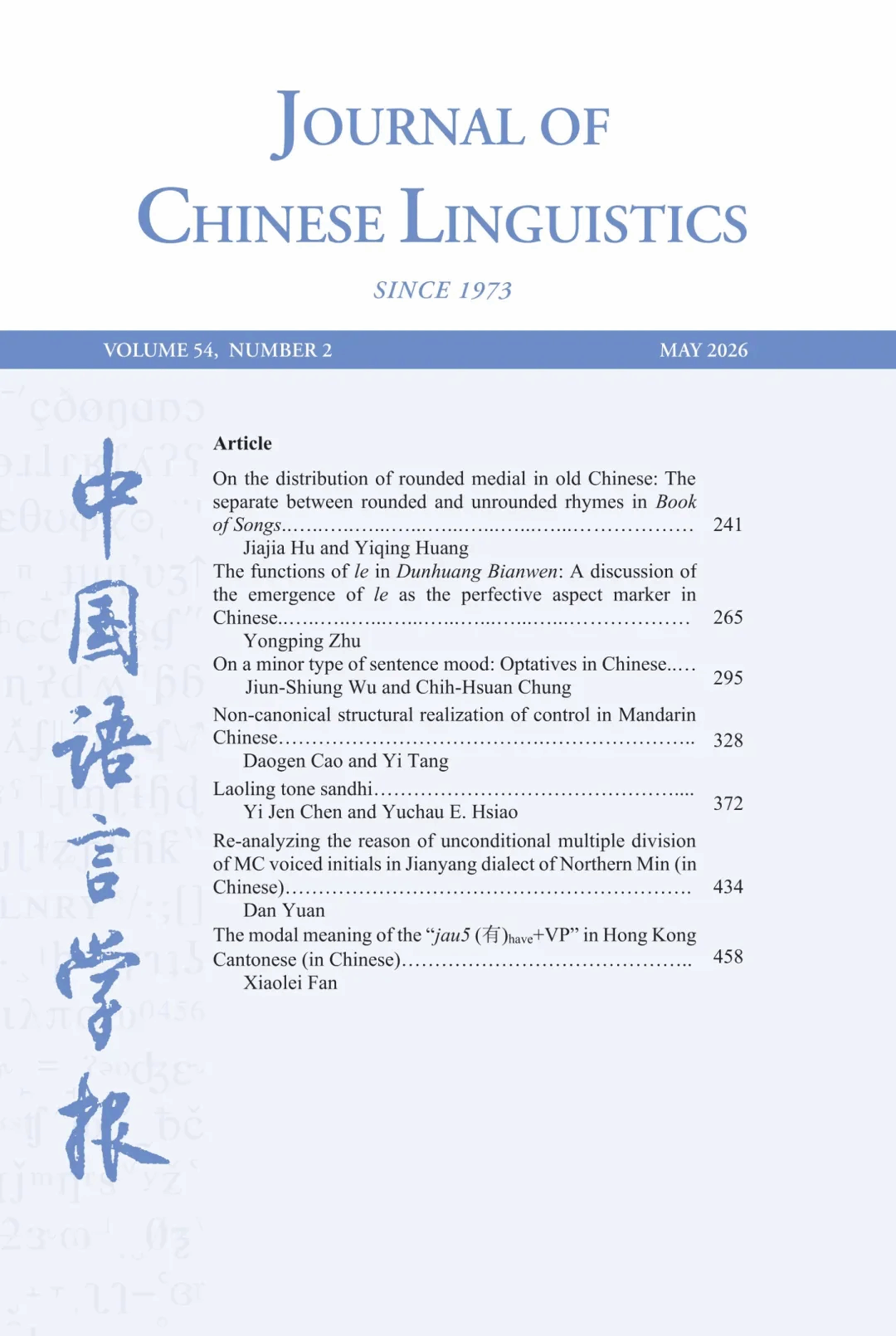
《中国语言学报》(Journal of Chinese Linguistics)
电子版获取渠道:Project Muse (2015至今)、Ariti Library (1973至今)、JSTOR (1973-2022)。
纸刊订阅渠道:https://jcl.fah.um.edu.mo/subscription/
Articles
ON THE DISTRIBUTION OF ROUNDED MEDIAL IN OLD CHINESE: THE SEPARATE BETWEEN ROUNDED AND
UNROUNDED RHYMES IN BOOK OF SONGS
上古合口音的分布与《诗》韵开合分押
Jiajia Hu
胡佳佳
北京师范大学
Yiqing Huang
黄易青
北京师范大学
Abstract
Based on a database of rhymings in Book of Songs, this paper proves that in old Chinese: (1) Dental-ending final (with coda [-t/-n/-d/-r] could have rounded medial [-u-] or [-w-]; (2) Finals in labial syllable (with labial initial) could be classified into two categories: Rounded and unrounded; (3) Velar-ending final (with coda [-k/-ŋ/-g]) had no rounded medial, but could follow a labialized initial [kw-] or [pw-]; and the labialized [w-] gave rise to rounded medial [-w-] in middle Chinese; (4) In Book of Songs, there was a tendency to distinguish rounded rhymes from the unrounded.
摘要
基于《诗》韵数据库,文章证明上古音如下问题:(1)收舌韵([-t/-n/-d/-r])可存在合口介音[-u-]或[-w-];(2)唇音字有开口与合口之分;(3)收喉韵([-k/-ŋ/-g])没有合口介音,其在中古为合口的,合口成分是由上古唇化声母([kw-/pw-])演变出的;(4)《诗经》押韵有追求开合分押的趋势。
THE FUNCTIONS OF LE IN DUNHUANG BIANWEN: A DISCUSSION OF THE EMERGENCE OF LE AS THE PERFECTIVE
ASPECT MARKER IN CHINESE
敦煌变文中“了”的功能:兼议汉语完成体“了”的产生
Yongping Zhu
朱永平
圣母大学
Abstract
This article is a comprehensive investigatory survey and analysis of the usages of 了LE in Dunhuang Bianwen from the perspective of syntactic form, information structure, and pragmatic function based on the usage-based construction grammar theory and Hopper’s notion about the perfective properties. Syntactically, the gradually formed V LE as one verb compound to take an object by analogizing the form V QUE O motivates the formation of the novel structure V LE O. Pragmatically, the need for a form to highlight the new information in a closed event with sequential activities under a swift situation in narrative discourse promotes the emergence of LE as the perfective aspect particle. The application of focus provides a window to observe the changes of LE from the focus on the predicate verb LE solely in the form V O LE, to the predicate V LE in which LE as a verb complement is the part of predicative focus in the form V LE, and eventually to the entire closed event in which LE as a perfective aspect particle to emphasize the event as a whole in the form V LE O. This study demonstrates that syntactic changes, analogization of existing grammar patterns, discourse needs in the specific usage context and pragmatic expressivity in communication all contribute to the emergence of LE as the perfective aspect marker.
摘要
本文参照基于使用的构式语法理论并借鉴Hopper提出的完成体属性的学说对敦煌变文中“了”的用法从句法形式,信息结构和语用功能进行全面深入的调查与分析。从句法上讲,“动+了”成为一个合成动词然后类比语法结构“动+却+宾”带上宾语促成了新结构“动+了+宾”的形成。从语用上看,在速动叙述语境下强调连贯活动中整体事件新信息的表达需要促使了完成体助词“了”的产生。通过观察“了”的焦点变化,可以看到在“动+宾+了”的结构中,谓语动词“了”是唯一的焦点;在动+了的结构中,谓语“动了”是焦点,“了”作为动词补语是焦点中的一部分;而在“动+了+宾”的结构中,整个结构成为焦点,“了”作为一个动态助词强调整个事件的完整性。本研究证明句法形式的变化,句法结构的类比,具体语境使用的需要和交际中的语用表达力都为完成体标记“了”的产生做出了贡献。
ON A MINOR TYPE OF SENTENCE MOOD: OPTATIVES IN CHINESE
论一个语气的次类别:汉语中的祈愿句
Jiun-Shiung Wu
吴俊雄
泉州师范学院
Chih-Hsuan Chung
钟芷轩
独立研究者
Abstract
This paper discusses Chinese optative sentences, which are constructed based on the optative construction in the form of a yàoshì/rúguǒ clause as a clausal subject plus a matrix clause jiù + positive adjectival predicate + le, such as jiù hǎo le ‘JIU nice Prc’. We propose an ordered possible world semantics for Chinese optatives. Given Optative (p), possible worlds are ordered according to how likely a proposition is true under normal circumstances and p is true in worlds in which a proposition wished for is true and which are lower in the ordered worlds. In addition, we also propose a Segmented Discourse Representation Theory account for the dynamic semantics of Chinese optatives. In addition to the (static and dynamic) semantics of Chinese optatives, we address three related issues: the construction undergoing grammaticalization, Chinese optatives expressing a counterfactual reading or not, and the use of different connectives jiǎshè/jiǎrú/rúguǒ/yàoshì.
摘要
本文探讨汉语中的祈愿句。汉语的祈愿句由“要是/如果条件句+就+正面谓语形容词+了”,如“就好了”。我们提出一个排序的可能世界语意。假设有个祈愿句optative(p),可能世界由命题在正常世界是多可能为真做排序,由低至高,而p在命题祈愿为真的世界中为真且在排序较低的世界为真。我们也提出片段篇章表述理论的动态语意来解释祈愿句在篇章中的作用。我们也讨论三个议题:祈愿结构正经历语法化,祈愿句是否表达假设语气及“假设、假如、如果、要是”四个条件连词是否能出现于祈愿句中。
NON-CANONICAL STRUCTURAL REALIZATION OF CONTROL IN MANDARIN CHINESE
汉语控制子句的非典型结构实现
Daogen Cao
曹道根
浙江财经大学
Yi Tang
唐仪
澳门大学
Abstract
Contending for the grammaticality of control sentences containing an overt controllee, we argue that Chinese control predicates may subcategorize for either nonfinite or finite controlled clauses. A nonfinite controlled clause instantiates canonical (minimal size) structural realization, while a finite controlled clause is a substantial CP instantiating non-canonical (larger-than-expected) structural realization. The latter forms an independent binding domain, thereby licensing an overt controllee. Finiteness of a Chinese controlled clause receives syntactic encoding to the extent that some element indicating the presence of a CP layer is mandatory. The free combination of a control predicate with a finite controlled clause is constrained by some overriding semantic/pragmatic considerations related to the categorical vs. thetic judgment type. A finite controlled clause expresses a categorical judgment, whereas a nonfinite controlled clause expresses the content of a thetic judgment. It is predicted based on the difference in judgment type that the subject of a finite controlled clause is not a minimal pronoun, in contrast to the PRO subject of a nonfinite controlled clause, which is a minimal pronoun. The binding relation between the null or lexical controllee subject of a finite controlled clause and its controller is semantic/pragmatic rather than syntactic in nature.
摘要
本文主张汉语控制子句或为非限定小句,或为限定小句,后者允准显性受控成分。非限定控制子句为控制动词补足语的典型(最小)句法实现,而限定控制子句为较完整的CP结构,是控制动词补足语的非典型(更大)句法实现;后者构成独立的约束域,从而允许显性受控成分出现。汉语控制子句的限定性有句法编码,即子句中必须包含能够标志CP层存在的成分。控制谓词与限定子句的合并受语义/语用因素制约,涉及主题判断与非主题判断区分。限定控制子句表达主题判断,而非限定控制子句表达非主题判断。基于这一差异,本文提出限定控制子句的主语并非最小代词,而非限定控制子句的PRO主语则是最小代词;此外,限定控制子句的显性或相应的隐性主语与控制语之间的约束关系本质上由语义/语用因素驱动,而非句法决定。
LAOLING TONE SANDHI
山东乐陵话的连读变调
Yi Jen Chen
陈怡臻
台湾政治大学
Yuchau E. Hsiao
萧宇超
台湾政治大学
Abstract
Previous studies of tone sandhi in Mandarin dialects have attributed tone sandhi motivations to phonotactics or allomorph listing due to the lack of phonetic or phonological grounding. They also observed that domains of sandhi rules within a dialect are either sensitive or non-sensitive to morphosyntactic configurations. In addition, the traditional parallelist framework of Optimality Theory (Prince and Smolensky [1993] 2004) usually suffices in previous analyses of opaque sandhi patterns. This study presents the trisyllabic tone sandhi patterns of Laoling, a Northern Mandarin dialect. In contrast to past research, we show that (a) the tone sandhi rules are phonetically and phonologically motivated, (b) the sandhi rules can differ in structure-sensitivity, and (c) there are opaque sandhi patterns that challenge the parallelist OT framework. We propose a serialist analysis under Harmonic Serialism (McCarthy 2010).
摘要
由于汉语方言变调经常缺乏明确的语音或音系动机,过去汉语方言研究多使用特定语言的声调序位限制(phonotactics)或词素变体(allomorph listing)来解释变调的动因。过去研究也指出,汉语方言内部的变调规则范畴仅可对句法构词敏感,或完全不敏感,但未发现结构敏感性的内部差异。再者,针对具隐晦性的连读变调,过去优选理论分析大多采用非派生之理论框架。本研究根据声学基频(F0)数据,整理山东乐陵话连读变调在三字组的运作模式,提出乐陵方言变调的语音与音系动机,且发现不同变调规则在结构敏感性上存在差异。本文亦发现乐陵连续变调在三字组的运作存在音系隐晦性,且无法用传统非派生之优选理论框架解释,故本文提出采用McCarthy(2010)的派生优选理论(Harmonic Serialism),对乐陵的变调隐晦性进行理论分析。
RE-ANALYZING THE REASON OF UNCONDITIONAL MULTIPLE DIVISION OF MC VOICED INITIALS IN JIANYANG
DIALECT OF NORTHERN MIN
闽北建阳方言全浊声母无条件多分原因再分析
Dan Yuan
袁丹
华东师范大学
Abstract
The analysis of this paper shows that: The unconditional multiple division of MC voiced Initials in modern Jianyang Dialect of Northern Min is neither because of the residue of proto Min nor the result of the mixture of multiple dialects, but the result of natural sound change. Given the MC voiced Initials in Jianyang dialect have two different kinds of voiced initials: “slack voice” type and “real voiced” type when the sound change happened, these two kinds of voiced initials have different “devoicing” and “lenition” sound change direction, and they mutually restrict each other in the diffusion sound change.
摘要
本文分析结果表明:造成今闽北建阳方言全浊声母无条件多分的原因,并非“原始闽语的残存”也非“方言混合”,而是自然音变。建阳方言全浊声母在发生音变时兼有“弛声”(“清音浊流”)和“振声”(声带振动)两种浊音类型,这两种类型“清化”和“弱化”的音变方向不一致,且在扩散式音变中“清化”音变被“弱化”音变所阻断,造成音变的残留,最终导致了全浊声母无条件多分的局面。
THE MODAL MEANING OF THE “JAU5 (有)have+VP” IN HONG KONG CANTONESE
香港粤语“有VP”的情态意义
Xiaolei Fan
范晓蕾
北京大学
Abstract
In Hong Kong Cantonese, the possessive verb jau5 (有) ‘have’ can also function as an auxiliary. It surfaces only in non-futurate dynamic episodic sentences, e.g., keoi5 gam1 jat6 jau5 sik6 zou2 caan1 (佢今日有食早餐) ‘he had breakfast today’. The auxiliary use of jau5 exhibits strict selectional restrictions to the context it appears in: Jau5 fails to occur in conversation starters, is incompatible with declaratives that bring up new information, and cannot surface in foregrounded sentences in narrative discourse. This study discovers certain patterns jau5-VP construction shows: For non-assertive sentences, jau5 is inclined to appear in polar questions, conditional clauses, and negative sentences. As for assertions, the occurrence of jau5 is only grammatical if VP-or-not? has, in previous conversation, already become the question under discussion (QUD). The contextual distribution of jau5 demonstrated in this study proves that jau5 encodes highlighted affirmation. It puts emphasis on the speaker’s belief that the content proposition of the utterance is true. This study may provide a useful framework for analyzing the forms corresponding to jau5 in other south-eastern Chinese dialects.
摘要
香港粤语的“有VP”表达相对非将来的动态事件,如“佢有食早餐嘅他吃了早饭的”。这种“有VP”句受到严格的语篇限制,它难以作对话的始发句单独成为一个话语片段,其陈述句排斥报导新信息,在叙事语篇中也无法作前景句。本文发现,“有VP”在非断言句中偏向用于一般问句、假设条件句和否定句,在断言句中要求前文预设一个在议问题“是否VP?”。“有”的这种分布态势证明该词编码了情态义“肯定凸显”,它往往起到强调确认的语用效果。本文的讨论可为研究东南汉语里相应功能的“有”提供一个分析框架。

