《中国语言学报》2026年54卷第3期(Journal of Chinese Linguistics Vol. 54, No.3)已出版。下面,我们将推送JCL最新一期(第53卷第3期)文章摘要——
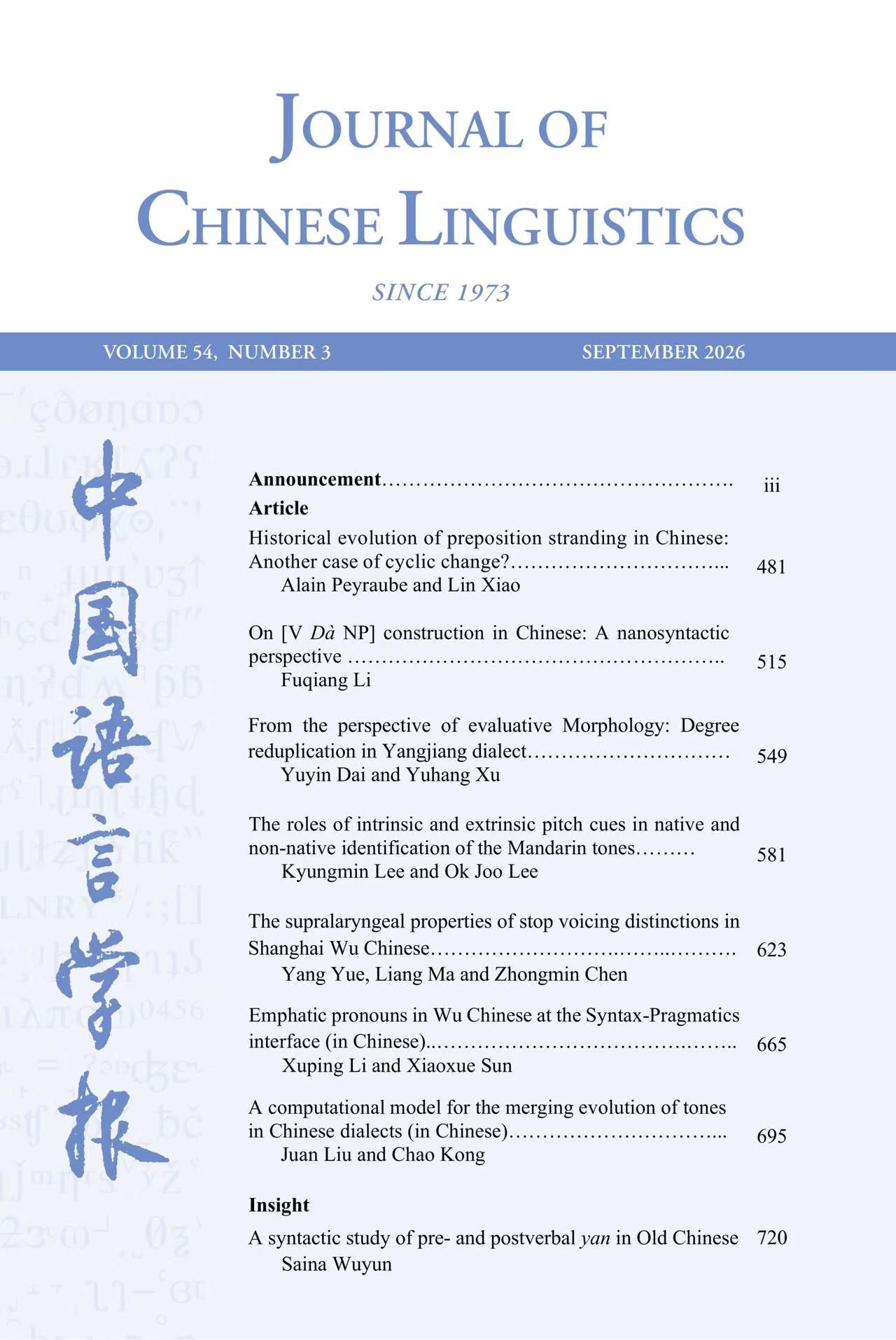
电子版获取渠道:Project Muse (2015至今)、Ariti Library (1973至今)、JSTOR (1973-2022)。
纸刊订阅渠道:https://www.jclhk.com.hk/subscription/
Articles
HISTORICAL EVOLUTION OF PREPOSITION STRANDING IN CHINESE:ANOTHER CASE OF CYCLIC CHANGE?
汉语介词悬空的历史演变:另一种循环演化?
Alain Peyraube
贝罗贝
法国高等社会科学研究院
Lin Xiao
肖琳
巴黎高等师范学院
Abstract
A number of cyclical changes have already been noted in the historical evolution of some syntactic structures of Chinese. The phenomenon of preposition stranding could be an additional example. Preposition stranding refers to a syntactic construction in which a preposition is left without a following object. This kind of construction is commonly found in English (where it usually occurs at the end of the sentence), but also in other Germanic languages or dialects, and also in some languages belonging to the Niger-Congo family, but it is almost non-existent in standard Mandarin. However, we can find stranded, hanging or dangling prepositions in contemporary various dialects, such as in the Zhangjiakou dialect (Hebei Province). It is also assumed that preposition stranding was quite common in Archaic Chinese up to the Early Medieval Chinese period. However, no systematic analysis has been done yet on these former stages of the Chinese language, and especially for Early Medieval and Late Medieval Chinese, when the Classical Chinese prepositions (comitative, instrumental, locative, ablative, allative, dative, etc.) yǐ and yú have become obsolete and have been replaced by other prepositions. This article tries to fill this gap and to show that there has been the following typological evolution from Archaic to Contemporary Chinese: [more preposition stranding] > [less preposition stranding] > [more preposition stranding]
摘要
一些汉语句法结构的历史演变已经被论证为循环演化(cyclical changes),介词悬空现象(preposition stranding)或可视为又一例证。所谓介词悬空,是指一种介词后不出现宾语的句法结构。这种结构在英语中十分常见(介词通常出现在句末),也见于其他日耳曼语及其方言,以及部分尼日尔—刚果语系语言;但在现代普通话中几乎不存在。然而,一些当代汉语方言,如河北张家口方言,仍可见到介词悬空(stranded)、悬置(hanging)或悬垂(dangling)的现象。此外,一般认为,介词悬空在上古汉语至中古早期阶段曾相当普遍。然而,对于早期汉语的这一现象,迄今尚缺乏系统研究,尤其是中古早期和中古晚期。这一时期正是古汉语介词——如兼表伴随、工具、处所、离格、趋向、与格等语义功能的“以”“于”等——逐渐废弃,并被其他介词取代的重要阶段。本文旨在填补这一研究空白,并论证从上古汉语到现代汉语,介词悬空现象经历了如下类型学演变:多介词悬空 → 少介词悬空 → 多介词悬空。
ON [V Dà NP] CONSTRUCTION IN CHINESE: A NANOSYNTACTIC PERSPECTIVE
汉语 [V Dà NP] 结构:纳米句法视角下的探索
Fuqiang Li
李富强
中国科学院大学
Abstract
This study investigates the syntactic architecture of the Chinese [V dà NP] construction within a nanosyntactic framework. The [V NP] compounds correspond to verb-object separable compounds (离合词 líhécí), which permit morphological separation and lexical insertion between the verb and the noun. Through corpus-based analysis and syntactic diagnostics, we demonstrate that dà in [V dà NP] construction functions as a degree adverb—analogous to English heavily in construction like drink heavily—rather than a size-denoting adjective. Crucially, dà lexicalizes a synthetic feature inventory (e.g., [+quantity], [+severity]), whose specific interpretation is contextually activated by the semantic properties of the [V NP] compounds, with features in a substitutional rather than additive relation. Syntactically, adopting nanosyntactic principles, we propose that dà heads the DegP as its lexicalized functional head, where it overtly spells out scalar features associated with event-level intensification. This analysis aligns with economy constraints, as the verb raises directly to vP without requiring additional focus-driven movement.
摘要
本文在纳米句法的框架下探讨了汉语中 [V大NP] 结构的构成。 [V大NP] 结构中的 [V NP] 属于动宾离合词,二者可以分开并在其间插入其他词。本文通过从语料库中选取 [V大NP] 结构并分析 [大] 的性质,认为 [大] 是一个表示程度的副词,类似于英语中的heavily (如,drink heavily) 的成分,并非是表示大小的形容词。我们认为 [大] 携带的特征形成了一个特征库,由于 [V NP] 复合词的不同解读,这些特征处于一种替代而非叠加的关系。在句法上,本文遵循纳米句法的原则,将 [大] 视为DegP的功能中心语,显性拼出与事件层级强化相关的标量特征。该分析使得动词直接提升到vP,无需额外的焦点驱动移位,符合经济性原则。
FROM THE PERSPECTIVE OF EVALUATIVE MORPHOLOGY: DEGREE REDUPLICATION IN YANGJIANG DIALECT
评价形态学视角下的阳江方言程度义重叠式
Yuyin Dai
戴瑜殷
华中师范大学
Yuhang Xu
徐宇航
澳门大学
Abstract
Evaluative morphology is a relatively new concept in the field of morphology, which has significance for the study of Chinese morphological phenomena. The present study comprehensively describes degree reduplication in Yangjiang dialect, further probing into its grammatical forms and semantic mechanisms from the perspective of evaluative morphology. Degree reduplication in Yangjiang dialect can be categorized into three types: (1) Degree-intensification reduplication, based on universal cognitive patterns, expresses the prototypical meaning big by prolonging the tone-change syllable and sometimes reduplicating it more than twice; (2) Degree-reduction reduplication expresses the prototypical meaning small by adding the suffix “tʃei21子” to the reduplication, which economically and effectively eliminates the “big amount” semantic preference of the double reduplication; (3) Reduplication with an indefinite degree features no special markers, relying on the depicted state to determine the degree. Degree reduplication in Yangjiang dialect not only has the features of Yue dialects but also reflects traces of contact with Min and Hakka dialects. It is a typical example of evaluative morphology and serves as a case study for examining evaluative morphology in Yue dialect and even in Chinese.
摘要
评价性形态是形态学领域较新的概念,对汉语形态现象研究具启发意义。本文全面描写阳江方言程度义重叠式,并依托评价形态学视角进一步探讨其语法形式和表义机制。阳江方言程度义重叠式可分为三类:(一)程度增强类重叠式通过延长变调音节时长和多叠表达原型意义“大”,该策略基于并符合“形式多即内容多”的人类普遍认知模式;(二)程度减弱类重叠式以双叠式加词缀“子”表示原型意义“小”,经济有效地通过词缀消解双叠式表大量的语义倾向;(三)程度不定类重叠式则无特殊标记,依托所描摹状态以确定程度义。同时,阳江方言程度义重叠式既具粤方言的特征,又体现与闽、客方言接触的痕迹。阳江方言程度义重叠式是评价性形态的典型例证,本文是运用评价形态学进行形态研究的一项具体实践,也为粤方言乃至汉语的评价性形态研究提供语料支持和个案参考。
THE ROLES OF INTRINSIC AND EXTRINSIC PITCH CUES IN NATIVE AND NON-NATIVE IDENTIFICATION OF THE MANDARIN TONES
内在和外在音高线索在母语者及非母语者听辨普通话声调时的作用
Kyungmin Lee
李京珉
首尔大学
Ok Joo Lee
李玉珠
首尔大学
Abstract
Pitch is most crucial for tone perception. Not only is the intrinsic pitch information from the target tone important, but the extrinsic pitch properties from adjacent tones also serve as notable cues. This study investigates the relative contributions of pitch height and movement variations utilized as intrinsic and extrinsic cues for Mandarin tone perception by native listeners and non-native listeners with varying exposure to L2 Mandarin. An identification experiment was conducted with 91 participants, who were instructed to judge tones created by synthesizing pitch extracted from real disyllabic expressions. Results reveal that while pitch heights and slopes are crucial intrinsic cues for identifying level and rising tones, respectively, the phonetic interactions between intrinsic and extrinsic pitch cues bear greater perceptual significance for both native and non-native perception, albeit to varying degrees depending on L2 proficiency. The pitch difference between neighboring tones is found to be the most significant cue; it not only has a stronger influence than intrinsic pitch cues but also significantly aids listeners in distinguishing tones categorically. By comparing native Mandarin listeners with native Korean listeners, a group whose language lacks lexical tones but uses post-lexical intonation, this study sheds light on the roles of L1 prosody and developmental factors that shape L2 listeners’ perceptual weighting strategies for both intrinsic and extrinsic pitch cues in identifying Mandarin tones.
摘要
音高是声调感知时最重要的声学线索。不仅目标声调的内在音高十分重要,且相邻声调的外在音高也是非常重要的线索。本研究分析了音高高度及变动的差异作为内在和外在线索,在汉语母语者和不同水平的二语者感知普通话声调时所起的作用。在本研究中进行了声调辨认实验,要求91名被试辨认音高经过合成的普通话双音节词语的声调。结果表明:虽然音高高度和音高斜率分别是辨认平调和升调时重要的内在线索,但内在和外在音高线索间的语音交互作用,在汉语母语者和二语者的声调感知上都具有更加重要的作用。尤其是相邻音调间的音高差,不仅比内在音高有更大的影响,且帮助听者以范畴的方式区分声调。此外,本研究还通过分析韩语(无声调仅有语调)为母语的二语者对声调的感知情况,阐明了母语的特点与二语熟练度对内在和外在音高线索的感知权重策略产生的影响。
THE SUPRALARYNGEAL PROPERTIES OF STOP VOICING DISTINCTIONS IN SHANGHAI WU CHINESE
吴方言上海话塞音清浊对立的喉上特征
Yang Yue
岳暘
复旦大学
Liang Ma
马良
复旦大学
Zhongmin Chen
陈忠敏
复旦大学
Abstract
This study utilized EMA and ultrasound imaging to investigate the voicing distinctions of stops in Shanghai Wu across 9 speakers by analyzing various laryngeal and supralaryngeal properties. Linear Mixed Model and Generalized Additive Mixed Models were conducted on the measurements in this study. The results suggest that some supralaryngeal and laryngeal properties within the mechanisms demonstrate a degree of independence in voicing distinctions as previously reported, while others also reveal interactions between these two modules. First, independence in this study is embodied in the different supralaryngeal articulatory targets between voiced and voiceless stops in the Shanghai Wu Chinese. Although word-initial voiced stops demonstrate laryngeal properties (e.g., VOT) comparable to voiceless stops—they markedly differ from their supralaryngeal properties—word-initial voiced stops were still found to be distinct from voiceless stops by their lower supralaryngeal articulatory targets. This distinction is specifically reflected in the dynamic loop and closure duration. Furthermore, interactions of the two modules in this study are embodied in the jaw displacement, length of the geniohyoid muscle, and tongue root displacement. Based on the results, this study further discusses the hybrid nature of word-initial voiced stops. We propose that this nature may arise from the interplay of factors associated with processes of gradual sound change and word-internal position constraints.
摘要
本研究通过电磁发音仪(EMA)与超声成像仪的实验手段,通过分析喉部及喉上发音特征,调查了9位吴方言上海话母语者塞音清浊区分的表现。研究运用线性混合效应模型与广义加性混合模型对测量数据进行分析,结果显示,如前人研究所述,一部分喉上和喉部机制的特征在清浊区分发音中存在一定的独立性,同时,这两个模块之间的其他部分机制的特征也存在交互性。首先,独立性体现在吴方言上海浊塞音和清塞音在喉上发音目标上的不同。尽管词首浊塞音表现出与清塞音相似的喉部特征(如VOT),但它们在喉上发音目标上存在显著差异——词首浊塞音因其较低的喉上发音目标而与清塞音有所差异。这种差异具体体现在发音运动回路和持阻时长上。此外,本研究中喉上与喉部机制的相互作用体现在下颌位移、颏舌骨肌长度和舌根位移上。基于这些结果,本研究进一步探讨了词首浊塞音的混合性质。我们认为,这种性质可能是由渐进音变过程和词内位置限制相关的因素共同作用而产生的。
EMPHATIC PRONOUNS IN WU CHINESE AT THE SYNTAX-PRAGMATICS INTERFACE
吴语强调式人称代词的句法-语用界面研究
Xuping Li
李旭平
浙江大学
Xiaoxue Sun
孙晓雪
浙江大学
Abstract
This paper reexamines the syntactic distribution of ‘emphatic pronouns’ formed by the prefixes 是(shi), 像(xiang) and 丐 (gai) in Wu Chinese, and reevaluates the semantic import of these so-called ‘emphatic pronouns’. We make two main claims concerning the syntactic and semantic properties of emphatic pronouns. First, we argue that the ‘emphatic’ meaning of complex pronouns in Wu is essentially a manifestation of discourse-oriented function such as topicality and focality, which are syntactically projected as the left periphery of the determiner phrase. Second, these three compound pronouns all underwent syntactic reanalysis from complementizer phrases (CPs) to determiner phrases (DPs). The sources of their emphatic interpretation can be further distinguished into mechanisms of focus prominence, topic continuity, and topic shifting. The syntactic commonalities and differences among these mechanisms can be attributed to the distinct lexical sources of each prefix, and to the divergent functional structures or associated semantic features (e.g., [+topic] vs. [+focus]) that they carried prior to reanalysis. The theoretical significance of this study lies in the fact that it provides independent evidence for the view that personal pronouns may project their own left-peripheral structure, thereby offering new corroboration for the syntactic parallelism between the nominal and verbal domains.
摘要
文章讨论吴语中由前缀“是/像/丐-Pron”构成的强调式人称代词在句法分布上的共性与差异,重新审视所谓的“强调式代词”的语义内涵。文章提出以下两个核心观点:(一)吴语强调式代词所承载的“强调”意义,本质上是话题、焦点等话语信息功能的体现,其在句法上投射为限定词短语的左缘结构(left periphery of DP);(二)这三类复合代词均是由标句词短语(CP)到名词性短语(DP)这一句法到形态跨层重新分析而来,其强调意义的来源可进一步区分为焦点凸显、话题延续和转换(topic continuity and shifting)等机制。这些机制在共时层面的句法共性与差异,可归结于其各自词汇来源,以及重新分析前相应的功能结构或相关语义特征的差异,如 [+话题] 或 [+焦点] 等。本研究在理论上的意义在于,为“人称代词的句法投射可以包括相应的左缘结构”这一观点提供了独立证据,从而为名词域和动词域之间的句法平行性做出了新的佐证。
A COMPUTATIONAL MODEL FOR THE MERGING
EVOLUTION OF TONES IN CHINESE DIALECTS
汉语方言声调合并演变的计算模型
——以山东40个方言的单字调系统为据
Juan Liu
刘娟
山东大学
Chao Kong
孔超
山东大学
Abstract
This article proposes a method for calculating the acoustic distance of Chinese tones and builds a computational model for investigating the evolution of the Chinese citation tone system based on the clustering algorithm and the acoustic confusion matrix. The application of this model to the investigation of the tone systems of 40 dialects in Shandong Province reveals that the clustering accuracy rate can quantify the stability of a tone system, and can be used to make horizontal comparisons across dialects to observe the macro-evolutionary trend of the tone systems. The confusion matrix can not only reveal the type of tonal merger evolution, but also showcase the direction and path of the merger evolution. The establishment of such a computational model based on acoustic data is helpful for us to quantify the evolution of Chinese tones, and to deeply and accurately understand the mechanism and rules governing the evolution of Chinese tones.
摘要
本文提出一种新的汉语声调声学距离的计算方法,并且基于聚类算法和声学混淆矩阵概念构建了一套用于考察汉语单字调系统演变的计算模型。使用山东40个方言的单字调系统对该模型进行验证考察时发现:聚类准确率能够量化地表达声调系统的稳定度,并据以进行跨方言的横向比较,观察汉语声调的宏观演变趋势。而混淆矩阵不仅能反映声调合并演变的类型,还能揭示合并演变的方向和途径过程。该模型对山东方言单字调系统的演变有很好的解释性。基于声学数据计算模型的建立有助于我们对汉语声调演变进行量化研究,深入认识和准确把握汉语声调系统演变的机制和规律。
A SYNTACTIC STUDY OF PRE- AND POSTVERBAL YAN IN OLD CHINESE
上古汉语动词前、后“焉”的句法研究
Saina Wuyun
乌云赛娜
陕西师范大学
Abstract
This study provides a comprehensive examination of the syntactic distribution and semantic interpretation of four distinct uses of yān 焉 in Old Chinese: (i) postverbal vP-internal yān, (ii) postverbal sentence-final particle (SFP) yān, (iii) preverbal interrogative yān, and (iv) preverbal negative wh-word yān. It is proposed that the low postverbal yān appears within the vP, functioning either as an object or a dative argument. This form may undergo vP-internal movement to the vP-edge position, triggered by a [+focus] feature on a functional v head and licensed through case feature sharing at the landing site. This movement gives rise to the preverbal interrogative yān. Furthermore, it is argued that the preverbal negative yān does not bear a derivational relationship with the low postverbal yān. Instead, it is base-generated at the vP edge, within the scope of a negator in the Polarity Phrase in the C-domain, carrying the illocutionary force of asserting the opposite polarity of the apparent question. Finally, the high postverbal yān functions as an SFP, occupying the C-domain. Both the postverbal SFP and the preverbal negative yān convey distinct illocutionary forces, highlighting their close interaction with pragmatic factors.
摘要
本研究考察上古汉语中四种不同“焉”的句法分布和语义解释,包括:动词后vP内“焉”、动词后句末语气助词(SP)“焉”、动词前vP内疑问词“焉”,及动词前vP内否定词“焉”。本文主张,低位的动词后“焉”基础生成于动词短语(vP)内部,作补足语或附加语;该“焉”受到v中心语上 [+焦点] 特征触发,可以移位到vP边缘位置,进而派生出动词前疑问词“焉”。动词前否定词“焉”与动词后vP内“焉”并无派生关系。它是在vP边缘位置基础生成的,在句法中位于CP辖域的极性短语内否定词作用的范围之内,带有表达相反极性的言外语力。动词后高位“焉”是一个句末语气助词,基础生成于CP层。动后语气词“焉”与动前否定“焉”均具有一定的言外语力,这展现了句法–语义与语用之间密切的互动关系。

